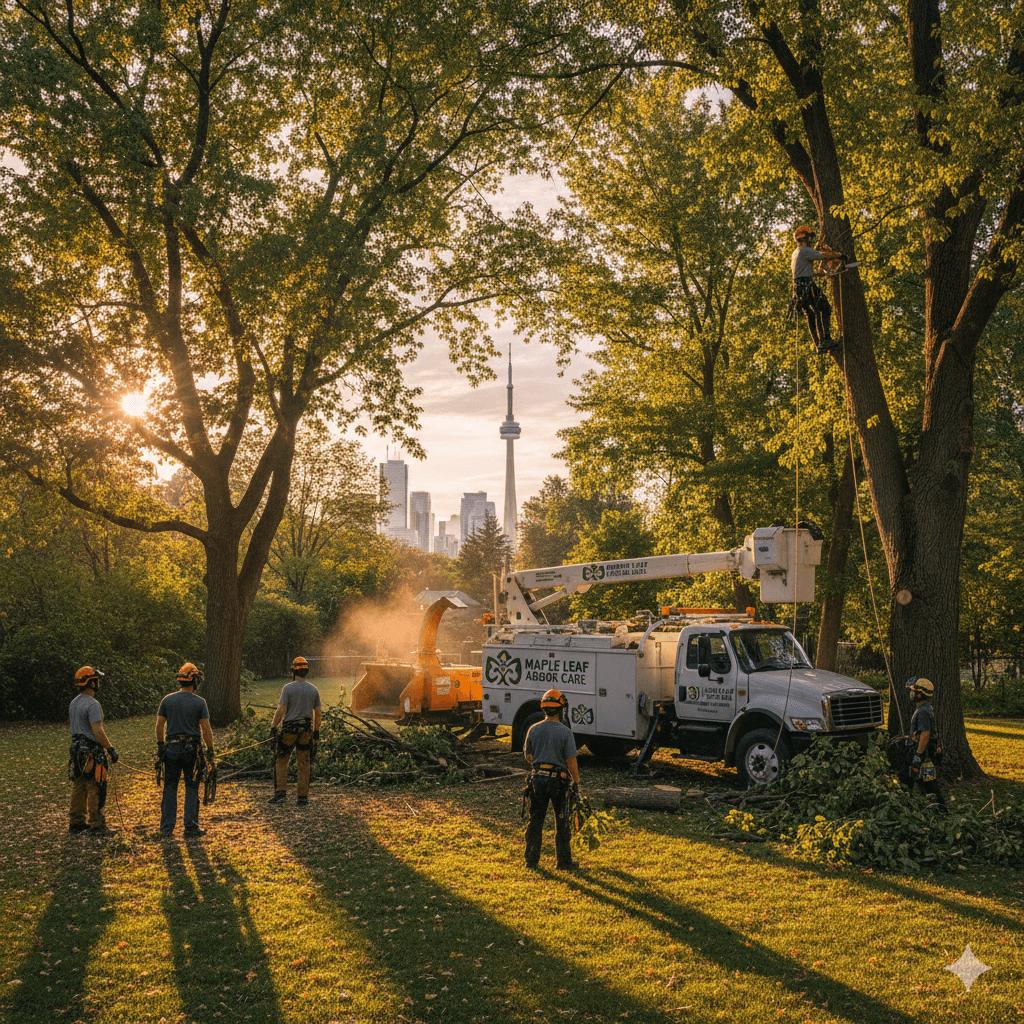
Run your crew and your paperwork off the same truck.
Tree care and arborist companies in the GTA and southern Ontario. Systems for permit paperwork, crew scheduling, storm response, and quoting off a site visit, built by people who run this kind of business.
The Mess We Fix
Quoting Off a Site Visit
You walk the property, price the removal or prune in your head, then still have to type it into a quote that night before the client forgets they called you.
Permit and Bylaw Paperwork
A private tree on a residential lot needs a different permit trail than a boulevard tree or one near a protected woodlot, and the wrong form stalls a job for weeks.
Storm Response Chaos
A windstorm turns your phone into a scoreboard of missed calls, and the jobs that get answered first are not always the ones with the most damage or the most risk.
What We Handle For You
Site-Visit-to-Quote
Turn site notes, dbh and species, and a hazard read into a professional quote before you're back in the truck, not after dinner.
Permit Document Tracking
One record per tree that holds the permit application, the arborist report if one was required, and the approval, so you can show it on demand instead of digging through email.
Storm-Day Triage
Incoming calls get logged and ranked by hazard (leaning over a driveway, on a hydro line, blocking a road) instead of by who called first.
Most software built for this trade is built by people who have never climbed a tree, cleaned up a downed limb off a car, or argued with a homeowner about why a stump grind costs what it costs. That shows up in the product: generic job-scheduling software with a tree-shaped icon slapped on the landing page, built for a lawn-care route or a general handyman business and then relabelled.
Tree care runs on a different rhythm than most trades. A landscaping crew’s day is mostly predictable. A tree crew’s day is a mix of booked pruning work, one or two removals that take longer than quoted because the lean was worse than it looked from the ground, and whatever the phone rings with between jobs. Software that assumes a flat, evenly-spaced schedule fights that reality instead of working with it.
Quoting is a site-visit problem, not a form-filling problem
Most tree work gets quoted after a physical look at the tree: species, diameter at breast height, lean, deadwood, proximity to a structure or a line, and access (can a crane truck get in, or is this a rope-and-rig job through a side yard). That assessment happens in your head, on site, in maybe five minutes. The quote that follows it should not take an hour that night.
What we build is a way to capture that same on-site read (species, hazard notes, access constraints, a photo or two) directly into a formatted quote before you’ve left the property, with your own pricing logic behind it (per-diameter-inch removal rates, a flat crane surcharge, a stump-grind add-on), not a generic line-item template built for a different trade.
Permits are a paper trail, and paper trails are exactly the problem
Almost every municipality in southern Ontario regulates private tree removal in some form: a permit threshold tied to trunk diameter, a requirement for an arborist report above a certain size, replacement planting conditions, or a different process entirely for a tree on a boulevard versus a tree on private property. The specifics differ by city and change, which is exactly why they belong in a record, not in someone’s memory or a folder of scanned PDFs.
We build the tracking layer: one record per job that holds the permit application, the supporting arborist report if the diameter triggered one, the approval or denial, and photos taken before and after. If a bylaw officer, an insurer, or a homeowner’s lawyer ever asks whether a removal was properly permitted, the answer is a lookup, not an afternoon spent searching email and a filing cabinet.
Storm response is the moment the system either helps or gets in the way
A serious windstorm changes tree work overnight from a booked schedule into triage. The phone rings constantly. Some of those calls are a downed branch on a driveway. Some are a split trunk leaning on a house. Some are a tree across a hydro line, which is not your job at all and needs to be routed to the utility instead of quoted.
The failure mode we’ve seen (and lived) is not too few calls, it’s too many calls with no way to sort them. Whoever answers the phone first becomes the priority, regardless of actual risk. What a proper intake system does on a storm day is simple: log every call with a hazard flag (on a structure, on a line, blocking a road, cosmetic) and let the office triage by risk instead of by call order. Nothing here requires new hardware or a new app on a technician’s phone mid-storm. It’s a disciplined intake process that holds up when the phone won’t stop ringing.
Crew scheduling around access, equipment, and weather
A landscaping route is mostly interchangeable: any crew with a mower can do most stops. Tree work isn’t. A removal needing a bucket truck can’t go to a crew running only climbing gear. A job with tight side-yard access might need a smaller chipper or a different truck entirely. And a lot of tree work simply can’t happen in high wind or heavy rain, which means a scheduling board needs to reshuffle fast without losing track of which jobs were half-started.
We build scheduling around those real constraints, not a generic calendar that assumes every job and every crew is interchangeable.
Where an off-the-shelf tool is honestly fine
If your business is small, mostly pruning and small removals, with simple pricing and no permit complexity, a general field-service tool (the kind built for landscapers, roofers, and pool companies alike) may cover what you need for a fraction of what a custom build costs. The wedge for a purpose-built system is real but narrow: permit and compliance tracking specific to municipal tree bylaws, storm-day triage that a generic scheduler doesn’t model, and quoting logic built around diameter, access, and equipment rather than a flat hourly rate. If none of those are a live pain point for your crew size, say so, and a lighter tool is the honest answer.
What this is built on
None of this is theoretical for us. The systems described here reflect operational patterns from hands-on work running tree care in the GTA: permit paperwork, crew scheduling around access and equipment, quoting off a walk-through, and the specific chaos of a storm day. We’re not describing a market we researched. We’re describing a Tuesday.
How We Help
Operational Efficiency & Automation
Streamlining everyday tasks, reducing administrative burden, and optimizing workflows.
Communication Solutions
AI-powered systems that handle calls, messages, and customer responses 24/7.
Tender & Grant Application Assistance
Support for navigating complex application processes for municipal/provincial tenders and grants.
How the Calendar Hits You
Demand in this business is not flat across the year. We size the systems for your busy weeks, not your average ones.
Spring
Storm cleanup overlaps with the start of pruning season, so crews are triaging emergency calls and working a booked schedule at the same time.
Summer
Peak removal and pruning season. This is also when most municipal permit applications get filed, because homeowners want the work done before fall.
Fall
A second storm season (wind and early ice) stacks on top of leaf cleanup and pre-winter risk assessments.
Winter
Slower for pruning, but this is when a lot of hazard-tree removals happen, because it's easier to see structural defects on a bare tree and easier to drop wood on snow without tearing up a lawn.
Helping teams across the GTA reclaim their time.
Ready to fix your tree care business workflow?
See exactly where you can cut costs and get more jobs out the door.
Book Your Free Assessment